It hardly seems like the sort of thing to make grown men cry: Taiwanese people counting votes by hand. But I saw it happen to one of my colleagues on election night. I also had a first-hand report from another friend who found himself tearing up at the sight. And I get teary, too, every time I see it. Here’s why: Taiwanese vote counting is a beautiful ritual that goes right to the heart of what democracy means.
Before we get into the counting, how do people vote?
Everyone is automatically registered in their hometown when they turn 20. It’s possible to change your registration address but many people continue to vote where they were born, so election day is a big day for travel. This year, a student organization at National Taiwan University raised over $80,000 to help young people return to their hometowns to vote!
Elections are always held on Saturday so workers don’t have to choose between earning a living and voting. This year the election fell at the end of the fall semester. The government required all universities to finish exams before election day so that students wouldn’t have to choose between studying and voting.
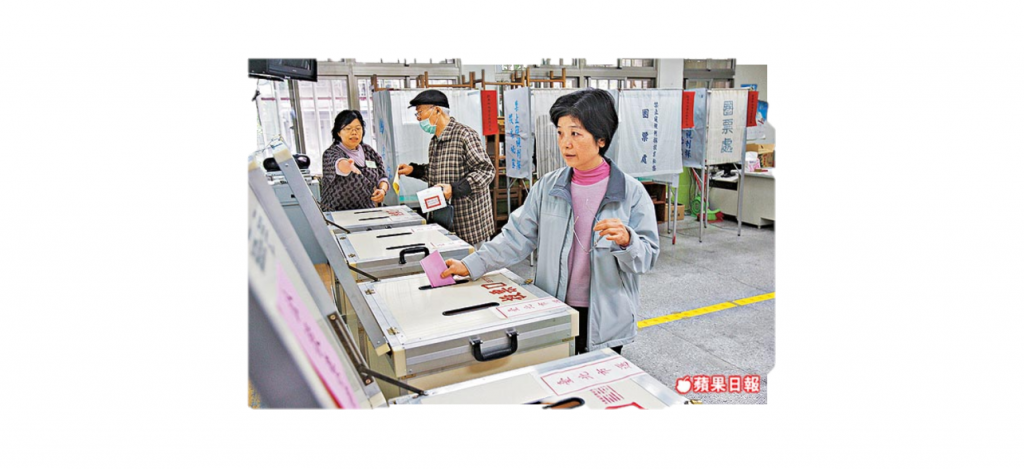
This photo shows the basic set-up of the polling stations. You enter and check in (you show your ID and your voting card, which ensures you’re in the right polling station). They hand you your ballots, and you go into the booths at the back of the photo. Then you put the ballots in the appropriate boxes, based on the color of the ballot.
Voters get a different ballot for each race. This year there were three: presidential (pink ballot), legislative district (yellow ballot), legislative party list (white ballot). There are reserved seats in the legislature for Taiwan’s indigenous peoples, so instead of a yellow ballot, indigenous voters received either a blue or a green one this year.
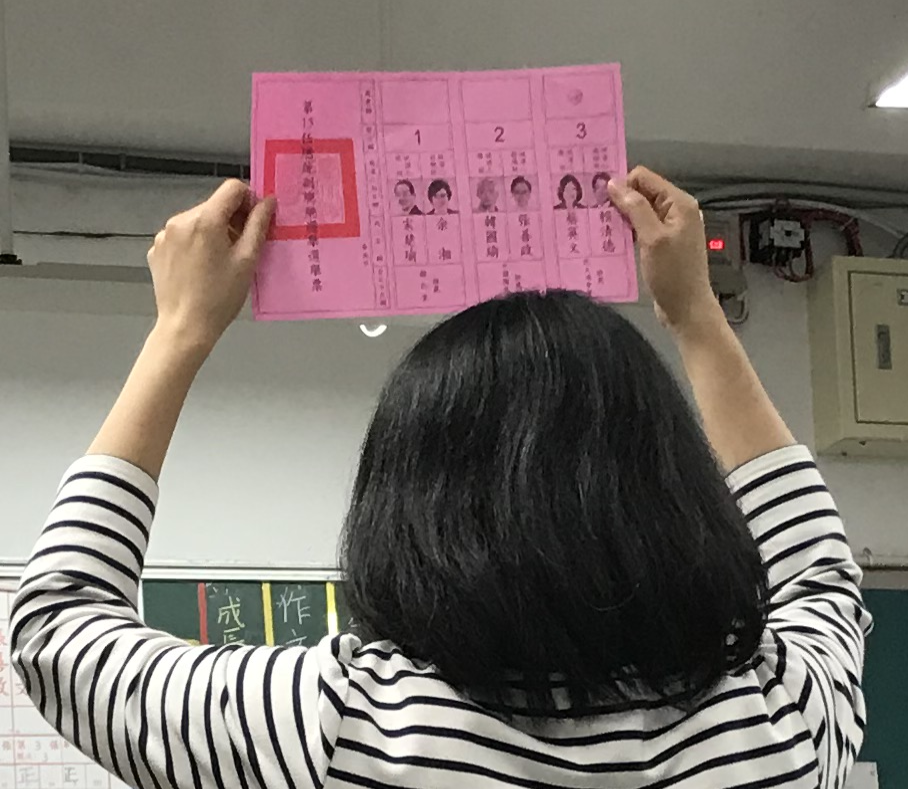
Here’s the 2020 presidential ballot. There were three sets of candidates (Presidential and Vice Presidential). Number 1 was James Soong and his running mate. Number 2 was Han Kuo-yu. Number 3 was Tsai Ing-wen. As you can see, the ballot includes pictures as well as numerical information and the candidates’ names. As long as you can recognize your candidate, you can vote. This ballot has been marked for Tsai Ing-wen: see the mark in the box above the number 3? You have to use a special stamp they provide at the polling station to mark your ballot.
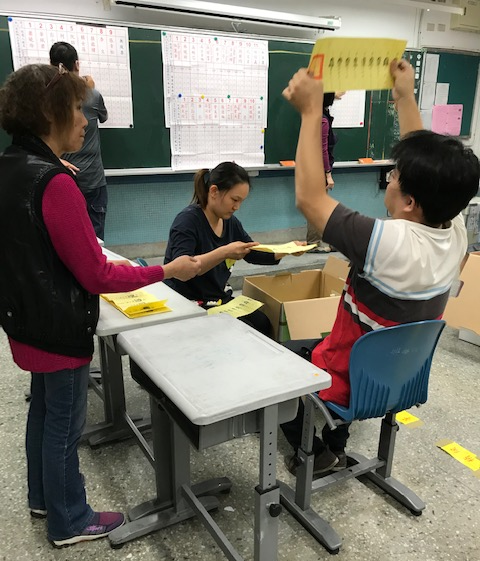
When the voting ends, the poll station workers seal up the ballot boxes. Once they have verified that everything has been done according to the law, they invite the public into the room for the counting.
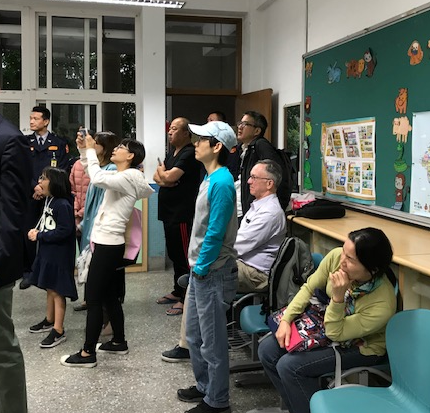
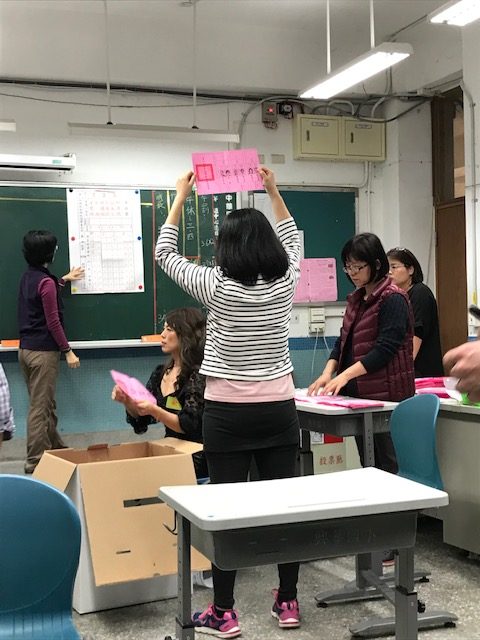
The people holding up the ballots call out the each vote. This is called “chang piao,” or “singing the vote.” When I took her picture, the woman singing the presidential vote was calling out, “Tsai Ing-wen, Number 3, One vote.”
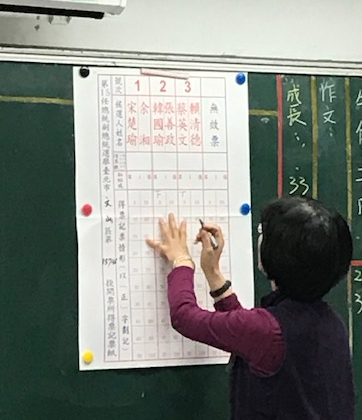
As the votes are called out, another person records them using tally marks on a paper at the front of the room. If there is a mistake in the reading or the recording, the observers are quick to point it out.
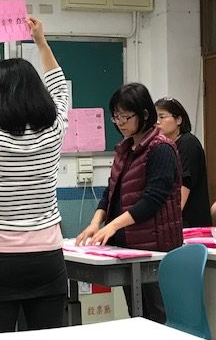
After she finished “singing” this ballot, Striped Shirt passed it to Puffer Vest to put in a pile with Tsai Ing-wen’s other votes. When the box was empty the ballots were counted again and the result compared to the result on the tally sheet. The confirmed totals were then transmitted to the Central Election Commission to be totaled with all the other polling stations. The observers keep track of the results in each polling station, so there’s no way to change the number later.
You might think this would take a long time, but in fact the presidential and legislative district ballots in this polling station were counted in less than an hour. The national results were all known and confirmed within a few hours. All of the ballots were transported to the Central Election Commission, where they could be recounted if needed.
And now it’s happening again: this cold-hearted social scientist is getting tearful just thinking about what it means to give people a paper ballot to mark, a ballot that cannot be altered, hacked, or ignored, and to invite citizens to oversee the counting of every ballot and to verify the result.
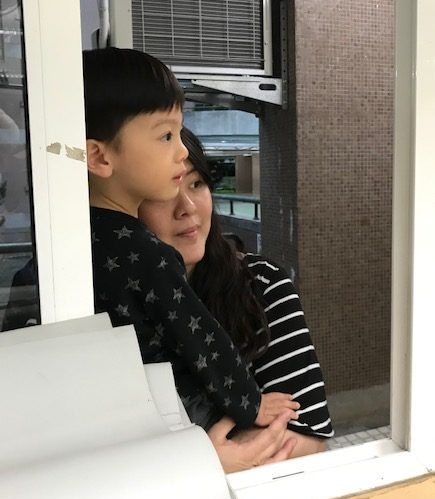

It is a wonderful report.
Thanks!
David Alexander: Citizen of Taiwan
My commentary on voting for the first time.
https://aboksu.wordpress.com/2020/02/09/something-went-right-something-went-wrong/
Congratulations! I will never forget meeting you on a train platform many years ago. And watching Katherine shock a group of Taiwanese men in Chicago by speaking her beautiful Hoklo.
Add on one thing, The counting process is videotaped by polling station staff and transported to the Central Election Commission along with ballots in the end.
The reason ballots need to be counted by hand and verified:
Because in the 70s and 80s the elections were rigged
I sometimes wish the American way can be as transparent..l DON’T trust the Democrats…